I'm not going to link to anything, because, you know, I basically just don't feel like looking up an altogether good article. But it's ok, because you've probably read this sort of thing, assuming you're the sort of person who does read these sorts of things. If you're not, then ok, this is new, but Google knows more about these things than I do.
Anyway, standing. It's good for you.
Take a second to soak that in, really drink in the implications. There's a fair body of research that suggests even such low intensity activity can improve insulin sensitivity, cognition, and all sorts of other good stuff. No need for crossfit, bro.
This is something baristas needn't worry about. Our job requires us to engage fully and frequently with our bipedal nature. This is cool, I think, and yet it's something I here a bit of bitching about, now and then. There are the usual complaints of sore feet, ankles, knees, and just generally lethargic legs.
Which, yeah, I understand. Shit happens, pain happens, and sometimes things don't feel great. That's life, welcome to it.
But I don't think it's quite that simple, really. I don't think standing all day has to suck, by definition. It can, I think, be rather effortless. If I'm being honest, it should be.
Small sample size, sure, but let's take my workplace as an example. We have 3 full time baristas. All of us stand for the length of the shift, and never mind doing so. Let's see if we can detect a theme.
Barista 1: Runs 50-70 miles a week in really light shoes, and does all the cross training stuff that goes along with.
Barista 2: Won a triathlon on a whim once, since she swims/bikes/runs for fun. Also competes in various martial arts tournaments - basically always wins.
Barista 3: Spends 2-6 hours outside of work at a dance studio, doing evil things to various tendons and ligaments.
Baristas 1/2/3: Get awkwardly excited about vegetables.
So there's that. Things to consider.

Showing posts with label health. Show all posts
Showing posts with label health. Show all posts
March 21, 2013


July 23, 2012
Muffin Anxiety
You can see it in how they stand, how they purse their lips and avoid your eyes. There is consternation written on their face, guilt about ordering what they want. Watch a customer eye a muffin, a starchy wad of forbidden fruit, delicious, decadent, but no, so much sugar, so much fat. They glance back and forth, say that they shouldn't, hoping you'll coax them one way or another. And you stand there, neutral.
This will probably not come as a surprise to anyone that knows me at all, but to others, perhaps this needs to be made clear: I am a bit of a health and fitness nut. I have very definitive opinions on how food quality fits in to that picture. However, despite that, my role at the coffee bar is not as a personal trainer or weight loss coach. I'll answer questions about ingredients honestly and clearly, but won't offer an opinion. It's simply not my place.
And yet I don't think that knowledge would help those customers. Paradoxically, we're a society that provides access to nearly endless decadence, and yet values abstinence from those things. Our hypothetical customer may want a mocha and a scone, but will abstain simply to show that they can.
We see this in a group setting. The faces and apprehensions are more exaggerated, as are the claims of how bad they want this particular food item, and how much they love it, but they can't, just can't, and so they won't. People want you, and everyone else, to know how bad they want the muffin, and thus how impressive it is that they can resist. It's flexing your willpower, not unlike the guy who makes love to his own image in the weight room mirror.
To be sure, this is a first world problem, and decadence in itself. To have the ability to decline calorie dense food is a luxury, and moreover, a suggestion of willpower. The resolute person is thin, because they're strong enough to make it so. This, of course, is a trait to be sought, and so we do.
Of course, I say all of this as a skinny guy, and not by accident. My friends are well aware that there are many things I won't eat, so they stopped offering me hot wings a long time ago. So I am not, in any way, criticizing the pursuit of health. Our bodies are all we really own, and there is nothing more important than what we do with them, and what we choose to fuel them with. It can be a decision fraught with guilt, with media pressure and personal values all coalescing. It can be complicated, and I get that.
But while it can be all of those things, it most certainly needn't be public drama. Order the latte with skim, soy, whole, whatever. Have the muffin or don't. Have whatever you want for whatever reasons you want.
And then, having what you want, relax. The freedom of choice is a beautiful thing. That we have everything from espresso to Coke to mochas to orange juice to plain black coffee is a beautiful thing. That the hardest decision you have to make in a given day is whether or not to eat a muffin is a beautiful thing. That you can basically eat or drink whatever you want is an unbelievable luxury, one the vast majority of humanity will never know. So at the very least, enjoy it. Guilt is not delicious.
This will probably not come as a surprise to anyone that knows me at all, but to others, perhaps this needs to be made clear: I am a bit of a health and fitness nut. I have very definitive opinions on how food quality fits in to that picture. However, despite that, my role at the coffee bar is not as a personal trainer or weight loss coach. I'll answer questions about ingredients honestly and clearly, but won't offer an opinion. It's simply not my place.
And yet I don't think that knowledge would help those customers. Paradoxically, we're a society that provides access to nearly endless decadence, and yet values abstinence from those things. Our hypothetical customer may want a mocha and a scone, but will abstain simply to show that they can.
We see this in a group setting. The faces and apprehensions are more exaggerated, as are the claims of how bad they want this particular food item, and how much they love it, but they can't, just can't, and so they won't. People want you, and everyone else, to know how bad they want the muffin, and thus how impressive it is that they can resist. It's flexing your willpower, not unlike the guy who makes love to his own image in the weight room mirror.
To be sure, this is a first world problem, and decadence in itself. To have the ability to decline calorie dense food is a luxury, and moreover, a suggestion of willpower. The resolute person is thin, because they're strong enough to make it so. This, of course, is a trait to be sought, and so we do.
Of course, I say all of this as a skinny guy, and not by accident. My friends are well aware that there are many things I won't eat, so they stopped offering me hot wings a long time ago. So I am not, in any way, criticizing the pursuit of health. Our bodies are all we really own, and there is nothing more important than what we do with them, and what we choose to fuel them with. It can be a decision fraught with guilt, with media pressure and personal values all coalescing. It can be complicated, and I get that.
But while it can be all of those things, it most certainly needn't be public drama. Order the latte with skim, soy, whole, whatever. Have the muffin or don't. Have whatever you want for whatever reasons you want.
And then, having what you want, relax. The freedom of choice is a beautiful thing. That we have everything from espresso to Coke to mochas to orange juice to plain black coffee is a beautiful thing. That the hardest decision you have to make in a given day is whether or not to eat a muffin is a beautiful thing. That you can basically eat or drink whatever you want is an unbelievable luxury, one the vast majority of humanity will never know. So at the very least, enjoy it. Guilt is not delicious.
May 21, 2012
Breaking: Coffee Fails to Prevent Death
Sometimes I link to things, because reading in a vacuum is hard. It's probably really dark in there, first of all, and the dust and everything else makes it quite gross. So sometimes I link to things, and not always James Hoffmann articles.
This will not be one of those times, however. I simply don't feel the need, in this case, since you've no doubt heard the news. In fact, people have probably been telling you by the dozen. Noting your frequent coffee toting, they take it upon themselves to deliver unto you this glorious news. That, of course, is that coffee drinkers tend to die older, and are less likely to contract all the bad stuff you want to avoid.
The original article was published in the New England Journal of Medicine, one of my absolute favorites, if you want to look it up. But I did just spoil the ending for you, so maybe you can skip it. Personally, I would, since I think the story really lacked a love interest and dragons. Stories are always better with love interests and dragons.
In any case, the authors surmise that frequent coffee drinkers seem to enjoy a myriad of health benefits, most notably, a decreased risk of death. Well, not exactly. You're still 100% likely to die, sorry to say, as is everyone else. Voltaire supposedly drank something like 50 cups of coffee a day, and yes, he's quite dead. Also, he was really smart, so if there were a loophole in this whole death thing, you'd think he may have found it. But no, he didn't, and neither will any of us.
But that all sounds like a bit of a downer, doesn't it? Well, fret not, since you do get all those other benefits you've heard about before, and that this article extends upon. Probably, coffee helps stave off diabetes, cancer, Alzheimer's, and dragons.
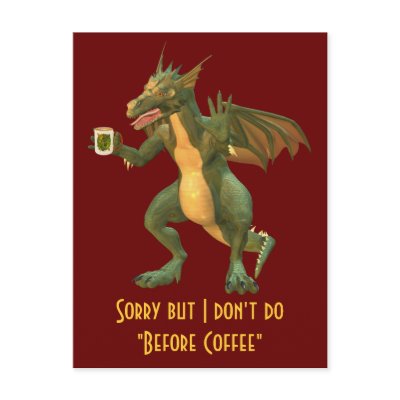 See? This guy is sated by his morning joe, and thus doesn't want to eat Joe. It all works out.
But really, drink coffee because it's awesome. Drink it for all of the reasons I've spent thousands of words grasping for, for the taste, the culture, the people, the experience. If you want health advice, eat a goddamn vegetable.
This will not be one of those times, however. I simply don't feel the need, in this case, since you've no doubt heard the news. In fact, people have probably been telling you by the dozen. Noting your frequent coffee toting, they take it upon themselves to deliver unto you this glorious news. That, of course, is that coffee drinkers tend to die older, and are less likely to contract all the bad stuff you want to avoid.
The original article was published in the New England Journal of Medicine, one of my absolute favorites, if you want to look it up. But I did just spoil the ending for you, so maybe you can skip it. Personally, I would, since I think the story really lacked a love interest and dragons. Stories are always better with love interests and dragons.
In any case, the authors surmise that frequent coffee drinkers seem to enjoy a myriad of health benefits, most notably, a decreased risk of death. Well, not exactly. You're still 100% likely to die, sorry to say, as is everyone else. Voltaire supposedly drank something like 50 cups of coffee a day, and yes, he's quite dead. Also, he was really smart, so if there were a loophole in this whole death thing, you'd think he may have found it. But no, he didn't, and neither will any of us.
But that all sounds like a bit of a downer, doesn't it? Well, fret not, since you do get all those other benefits you've heard about before, and that this article extends upon. Probably, coffee helps stave off diabetes, cancer, Alzheimer's, and dragons.
But really, drink coffee because it's awesome. Drink it for all of the reasons I've spent thousands of words grasping for, for the taste, the culture, the people, the experience. If you want health advice, eat a goddamn vegetable.
October 24, 2011
Coffee's Advocate
Another day, another study suggest that - more than make life worth living - coffee might well save it. This is not particularly noteworthy, in and of itself. The study only notes a correlation, which proves little to nothing. What's more, the mechanism is unclear, and the gap in consumption is massive. So what we've learned, really, is that people who drink a lot of coffee tend to have once type of cancer less than people who drink almost none. As such, there is no call to action, and it's said that people shouldn't start drinking coffee if they don't already enjoy it.
Were this one isolated case, I'd agree. Taken by itself, this one study isn't significant enough to support advocacy. But taken on the whole, there's a massive (and growing) body of evidence that suggests coffee deserves to be considered alongside fruits and veggies as potent natural medicine. And those, of course, are advocated for (however ineffectually).
Fruits and veggies are justifiably considered nutritional necessities, containing vitamins and phytonutrients that do innumerable good things inside the human body. But for all of the studies that suggest this, there are precious few that provide a causative link. And like the above study, taken on an individual basis, one might not think an apple a day worth eating. But we know better. We can take the cumulative knowledge, and glean from it that people should eat colorful plants, often at the exclusion of less nutritive things.
Thus, increase consumption of fruits and veggies; decrease consumption of less nutrient dense pseudo-food is considered sound advice.
In that same vein, I offer the following: Increase consumption of coffee, tea, and water; decrease consumption of sweetened liquids.
That, I think, is reasonable advocacy. No one needs to like coffee. But no one needs to like kale, either. You'd still be better off eating a side of that than french fries. So too can people make wise choices in their quest to hydrate and caffeinate. Coffee is a good one. So is tea, and of course, water. Anything sweetened, on the other hand, is probably not a good decision - whether it's sugar or sucralose/asparatame/neotame/etc. doing the sweetening.
Were this one isolated case, I'd agree. Taken by itself, this one study isn't significant enough to support advocacy. But taken on the whole, there's a massive (and growing) body of evidence that suggests coffee deserves to be considered alongside fruits and veggies as potent natural medicine. And those, of course, are advocated for (however ineffectually).
Fruits and veggies are justifiably considered nutritional necessities, containing vitamins and phytonutrients that do innumerable good things inside the human body. But for all of the studies that suggest this, there are precious few that provide a causative link. And like the above study, taken on an individual basis, one might not think an apple a day worth eating. But we know better. We can take the cumulative knowledge, and glean from it that people should eat colorful plants, often at the exclusion of less nutritive things.
Thus, increase consumption of fruits and veggies; decrease consumption of less nutrient dense pseudo-food is considered sound advice.
In that same vein, I offer the following: Increase consumption of coffee, tea, and water; decrease consumption of sweetened liquids.
That, I think, is reasonable advocacy. No one needs to like coffee. But no one needs to like kale, either. You'd still be better off eating a side of that than french fries. So too can people make wise choices in their quest to hydrate and caffeinate. Coffee is a good one. So is tea, and of course, water. Anything sweetened, on the other hand, is probably not a good decision - whether it's sugar or sucralose/asparatame/neotame/etc. doing the sweetening.
November 24, 2010
Men's Health Publishes Something Not About Erections or Biceps
Men's Health, by in large, stirs up a mixture of frustration and resentment in my gut. This owes mostly to the fact that the publication seems intent on promising all-night sex romps, bulging biceps, fast cars, faster race times, and just about anything else our idealized male should want. Which is not to say, of course, that these things are not desirable. My point is merely that one might be better of seeking rational advice when it comes to those things, rather than exaggerated promises.
Now all of that said, menshealth.com is on my (rather extensive) list of websites which get a daily visit. I tend to choose sites, not because I agree wholeheartedly with their conclusions, but because I am interested in their content, or they provide reasonable information. In fact, I frequent several sites which espouse views I decidedly do not adhere to myself. Men's Health, occasionally, falls in that category.
But I must give credit where credit is due. http://blogs.menshealth.com/health-headlines/a-cupful-of-cancer-fighting-goodness/2010/11/24 That link, right there, is a fantastic little read, citing a study which shows ANOTHER health benefit, enjoyed by coffee drinkers. Both of the other links in the article are good reads but *ahem* nothing I haven't written about myself.
Coffee seems to be protective against a number of degenerative diseases?
And what's that? It's best when fresh ground, and prepared manually?
While this stuff isn't groundbreaking, it is nice to see a decidedly mainstream publication - in fact, the most read in America - jumping all over the coffee bandwagon.
Now all of that said, menshealth.com is on my (rather extensive) list of websites which get a daily visit. I tend to choose sites, not because I agree wholeheartedly with their conclusions, but because I am interested in their content, or they provide reasonable information. In fact, I frequent several sites which espouse views I decidedly do not adhere to myself. Men's Health, occasionally, falls in that category.
But I must give credit where credit is due. http://blogs.menshealth.com/health-headlines/a-cupful-of-cancer-fighting-goodness/2010/11/24 That link, right there, is a fantastic little read, citing a study which shows ANOTHER health benefit, enjoyed by coffee drinkers. Both of the other links in the article are good reads but *ahem* nothing I haven't written about myself.
Coffee seems to be protective against a number of degenerative diseases?
And what's that? It's best when fresh ground, and prepared manually?
While this stuff isn't groundbreaking, it is nice to see a decidedly mainstream publication - in fact, the most read in America - jumping all over the coffee bandwagon.
November 4, 2010
It's Whatever
Perhaps I know why there are so many paleo blogs floating around out there now... that was easily the most hits any post I've written has garnered. Easily. I suppose, were hits the sole metric for gauging my success here, I might take the hint, scramble some eggs with a big pat of butter, and head out the door, sans oatmeal or bread. Then, I should blog about how I have this totally new energy, plummeting body fat levels, and any other health benefit you could think up.
These are the things I would say, because they are the things others say. Paleo diets are, in large part, successful because they offer people a solution well outside the mainstream. "It's not your fault. You didn't over-eat and sit around too much. No, it was the evil grain that got you fat. Now have a steak."
It might sound like I'm mocking these people. But in truth, I don't begrudge anyone their success. Look at any diet book, any nutrition blog, and you will find scores of people claiming that this way of eating fixed everything that was wrong in their life. People who feel better eating no meat, to almost only meat, to any extreme you can imagine.
What works, works. And it's good that they found what works for them.
Coffee, of course, works for me. I bring this up, because, not unlike many food bloggers, I seem something of a militant fanatic for my lifestyle. Drinking coffee, and lots of it, works great for me. And I tend, of course, to think that it should work just about as well for just about everyone else too.
I know this not to be the case, however. It's not that I think coffee is unhealthy. I think the scientific literature pretty clearly supports the opposite being true, in fact. But rather, if someone does not like coffee, or does not feel well when drinking it, then they probably don't need to drink it.
If two different people can lose weight, lower cholesterol, and banish any manner of health problem by adhering to as divergent of diets as exist, then clearly, as if we needed more proof, there is a individuality to the functioning of the human animal. For some, coffee fits in to that picture beautifully. For others, it does not. And though I can hardly fathom that reality, I know it exists.
Which is for the best, really. More coffee for those who want it.
These are the things I would say, because they are the things others say. Paleo diets are, in large part, successful because they offer people a solution well outside the mainstream. "It's not your fault. You didn't over-eat and sit around too much. No, it was the evil grain that got you fat. Now have a steak."
It might sound like I'm mocking these people. But in truth, I don't begrudge anyone their success. Look at any diet book, any nutrition blog, and you will find scores of people claiming that this way of eating fixed everything that was wrong in their life. People who feel better eating no meat, to almost only meat, to any extreme you can imagine.
What works, works. And it's good that they found what works for them.
Coffee, of course, works for me. I bring this up, because, not unlike many food bloggers, I seem something of a militant fanatic for my lifestyle. Drinking coffee, and lots of it, works great for me. And I tend, of course, to think that it should work just about as well for just about everyone else too.
I know this not to be the case, however. It's not that I think coffee is unhealthy. I think the scientific literature pretty clearly supports the opposite being true, in fact. But rather, if someone does not like coffee, or does not feel well when drinking it, then they probably don't need to drink it.
If two different people can lose weight, lower cholesterol, and banish any manner of health problem by adhering to as divergent of diets as exist, then clearly, as if we needed more proof, there is a individuality to the functioning of the human animal. For some, coffee fits in to that picture beautifully. For others, it does not. And though I can hardly fathom that reality, I know it exists.
Which is for the best, really. More coffee for those who want it.
October 25, 2010
Coffee and health
I had an odd task today. Odd, in that in seemed something that, to me, shouldn't need doing at all. As I set about trying to sell coffee as a healthy beverage to my communications class, it became clear to me that misconceptions persist.
To lay it out, as plainly as possible, the general public still seems to think of coffee as something of a guilty indulgence. It is useful, they think, only insofar as it provides a caffeine buzz. But even that, they fear, can be addicting, and thus should be limited.
Basically, the evidence goes like this: Coffee drinkers have significantly reduced risk of developing diabetes, Parkinson's and Alzheimer's. The statistics are consistent and weighty enough that, although correlation never proves causation, coffee must be considered at least a positive factor in staving off those diseases.
Most people do not have the desire to read medical journal articles concerning coffee, of course, but if you do, google scholar and pub med have endless material to pour over.
Even still, most people seem to think that these statistics are somehow accidental, that healthy people just happen to drink coffee, say, not that coffee has health benefits. Worse, many still impose imaginary harms on coffee.
Once upon a time, there were those who thought coffee caused cancer. Thankfully, that line of bull has mostly been done away with. But even still, equally inaccurate statements persist. Coffee causes high blood pressure, stomach ulcers, sleep apnea, etc. Worse yet, caffeine is addicting.
Conventional wisdom, in this case, is anything but. There is no data that shows any sort of positive correlation between coffee and hypertension, excessive stomach acidity, or any of the other negative health effects one might dream up. And there is no such thing as caffeine addiction. That is not my opinion, but rather the official medical stance. It is not classified as a drug of dependence; therefore, one can no more be addicted to coffee than apples, grilled cheese sandwiches, wearing pants, etc. Demonstrating a preference for any one of those things, or even habitual use, is not the same as addiction.
As best I could, I said as much in class this morning. I'm not sure I changed any minds, of course, as that's very hard to do. But at the very least, I hope I made people question some of the assumptions they take for granted.
To lay it out, as plainly as possible, the general public still seems to think of coffee as something of a guilty indulgence. It is useful, they think, only insofar as it provides a caffeine buzz. But even that, they fear, can be addicting, and thus should be limited.
Basically, the evidence goes like this: Coffee drinkers have significantly reduced risk of developing diabetes, Parkinson's and Alzheimer's. The statistics are consistent and weighty enough that, although correlation never proves causation, coffee must be considered at least a positive factor in staving off those diseases.
Most people do not have the desire to read medical journal articles concerning coffee, of course, but if you do, google scholar and pub med have endless material to pour over.
Even still, most people seem to think that these statistics are somehow accidental, that healthy people just happen to drink coffee, say, not that coffee has health benefits. Worse, many still impose imaginary harms on coffee.
Once upon a time, there were those who thought coffee caused cancer. Thankfully, that line of bull has mostly been done away with. But even still, equally inaccurate statements persist. Coffee causes high blood pressure, stomach ulcers, sleep apnea, etc. Worse yet, caffeine is addicting.
Conventional wisdom, in this case, is anything but. There is no data that shows any sort of positive correlation between coffee and hypertension, excessive stomach acidity, or any of the other negative health effects one might dream up. And there is no such thing as caffeine addiction. That is not my opinion, but rather the official medical stance. It is not classified as a drug of dependence; therefore, one can no more be addicted to coffee than apples, grilled cheese sandwiches, wearing pants, etc. Demonstrating a preference for any one of those things, or even habitual use, is not the same as addiction.
As best I could, I said as much in class this morning. I'm not sure I changed any minds, of course, as that's very hard to do. But at the very least, I hope I made people question some of the assumptions they take for granted.
Subscribe to:
Posts (Atom)