"People with college degrees are working at Starbucks."
The horror. The shame they must feel, to go to work every day, to make money for making coffee. Better that they go back to school. Better that they seek more degrees, further confirmation of intellectual worth. What a terrible economy this is. A cubicle for every man; that should be the goal. Let those without degrees make things; let them sully their hands.
Ahem. Some context, perhaps.
I heard that quote on NPR today, uttered by a reporter while discussing the difficult economy. It seems a degree doesn't guarantee anyone an office these days. Nor - and this is the implication - does it promise a job of which one can be proud.
This will not be a post about chasing your dreams, or about doing what makes you happy. No, this is more about pragmatism, and elitism.
On pragmatism: A job is a job, and "real" if the money is. While most baristas (myself included) are not payed lavishly, the money is usually sufficient. It is, in most cases, what a recent graduate would make in most any other field, especially when tips are factored in. And if we're talking specifically about Starbucks, it needs to be said that the giant pays quite well, and offers a lot of room for advancement.
On elitism: A person with a degree is no better than a person without, and no more deserving of a job that pays enough, or the satisfaction that comes from doing it.
I have a degree from the University of Kansas in English, obtained without a great deal of effort, and in large part, because I was born in to fortunate circumstances. I had good schools, enough money, clothes, and food. I had a stable family unit and plenty of friends. Change those variables, and the degree may change - or even disappear.
In any case, degree or no, why is physical labor shameful? Does fixing cars require less processing of information and problem solving skills than trading stocks? Even if it did, does that make the job - and thus, those who do it - any less necessary?
Of course not. And yet we still get quotes like that, meant as an off-hand jest, but nonetheless full of judgment. And that's really a shame. Everyone does something with their lives, and there are worse paths than employment at Starbucks.

Showing posts with label starbucks. Show all posts
Showing posts with label starbucks. Show all posts
April 9, 2012


March 31, 2012
Beetlejuice
I imagine customers might be bothered if I tossed a beetle in the blender with their drink.
The story provides all the facts, and no opinion, which is why I chose it for the link. You see, I have a rather hard time mustering much in the way of anger over this topic. Truthfully, I have a hard time mustering much of an opinion at all.
The uproar seems to come, mostly, from two camps: Those who think it's just nasty, and those who are vegan.
To the those who think it's gross: Well, maybe it is. But it's certainly common. And if you knew everything you were consuming, every time you sipped a fast food concoction... well, a bug might not be the nastiest thing.
To the vegans: Don't drink it. You're not going to miss much, I promise. If you had it in the past, don't beat yourself up over it. These things happen, and you're doing the best you can.
This is not to say that I wholly agree with Starbucks' logic here. While moving away from artificial ingredients is fine as a general practice, this is still a giant sugar bomb. It is as far removed from strawberries as Coca Cola is from kola nut. And really, are we that concerned over a little red food coloring? Some think it causes ADD, but again, I'd posit that it's the sugar in processed foods that is the more likely culprit. The research, to this point, agrees.
But this is not a story about health, so much as it is consumer power. If sales take a big enough hit, Starbucks may make a change, or remove the drink altogether. So while this is something of a non-story, it has the chance to grow in to an interesting case study.
January 22, 2012
Blonde Ambition: A Starbucks Veranda and Willow Review
It's said that gentlemen prefer blonds. Increasingly, this is the case in the coffee community. The belief is that roasting a bean deprives it of some essential flavor, and that to minimize that loss, the roast should be as short as possible. But until recently, this was a trend isolated to the specialty coffee community. The larger corporate entities still promised "bold" options (read: dark as hell), with the implication being that lighter was weaker.
No longer. The nation's largest coffee companies (Starbucks and Caribou) are both offering their lightest roasts to date. I'll have a more in depth discussion of Caribou's offerings, probably later this week. Starbucks, for its part, offered up the Willow and Veranda blends.
The former is comprised of Latin American and East African beans. As such, there is a hint of acidity in the cup. It is a delicate bite, however, and will strike the experienced Yirgi drinker as decidedly subtle. But if we assume that the average Starbucks drinker has not ventured far beyond the realm of the green apron, this coffee will probably be an eye opener. Because while it is light in roast, it is not without taste.
The Veranda blend is yet more subtle. The African beans are absent here, and as such, the hint of acid and wine is missing. What is left is a smooth, mellow coffee, but without any pronounced flavor notes. It sits lightly on the palate, and will probably serve as a comfortable entre in to the world of lighter beans for the dedicated Pike's Place drinker.
For me, both coffees pass the "Would I pay for it?" test. My affinity for African beans would suggest that I prefer the Willow, and I do. However, the Veranda is nice as well. Neither will steal market share from small batch roasters, coaxing the character out of single origin beans. In fact, they may well add to it, by expanding the palate of the average American coffee drinker. Thus the expansion to the Starbucks line is, I think, good news for everyone, regardless of preference.
September 22, 2011
Starbucks' Anniversary Shirts
Nevermind the loosely enforced dress code, I'd almost always wear black regardless. Perhaps it's an aesthetic representation of my coffee preference, or maybe just another step towards my inevitable hipsterism. In any case, my fashion sense is limited mostly to monochromatic shirts, paired with whatever jeans lack visible stains at the time. If I'm not running, that's probably what I'm wearing.
But inevitably, there are those in the coffee community who have more broad sartorial desires. Provided they're Starbucks fans, several name designers may have something to offer them.
But inevitably, there are those in the coffee community who have more broad sartorial desires. Provided they're Starbucks fans, several name designers may have something to offer them.
For $85, celebrate Starbucks’ 40th anniversary. Three noted designers — Alexander Wang, Sophie Theallet, and Billy Reid — have been tapped to create the $85 t-shirts commemorating the coffee company’s anniversary. The trio are all past recipients of the Council of Fashion Designers of America/Vogue Fashion Fund award, which offers grants to emerging American designers.
The t-shirts will be available at Nordstrom or can be bought online directly from Starbucks itself.
All three tees relate back to coffee and Starbucks’ business, with Theallet’s cleverly covered in a map of the world, apparently to represent the chain’s global ubiquity. We particularly like Wang’s tee for its subtle utility, however — it depicts a milky coffee stain turning into Starbucks’ Siren logo. So when you eventually spill coffee on your designer t-shirt while rushing to work, you can just claim that splatter is supposed to be there.
http://thehighlow.com/2011/09/designers-collaborating-with-starbucks/
June 7, 2011
The Empire Strikes Back

I wrote, just a few days ago, that Starbucks' ubiquity and presence is not so damaging as some make it out to be, and in fact, may be beneficial. My argument is best summed up with an old saying: A rising tide lifts all boats. And while truisms frequently are not, there is relevant wisdom in this case.
But good, bad, or indifferent (as if anyone with an interest in coffee could be) feelings aside, there is no denying that Starbucks is a major player in the food service realm, a titan that so eclipses the coffee category that it scarcely belongs in it.
May 31, 2011
The Comfortable Fallacy

Narratives work. They makes sense, and more importantly, they make other things make sense. They are more than a telling of events; they are a way of framing those events. We want the story understood and felt a certain way, so we tell it a certain way, cast certain characters a certain way.
Despite that -- or perhaps because of it -- they are simple. Characters are not just cast; they are miscast, colored black or white, void of nuance.
I was reminded of this, following game 1 of the NBA finals last night. The Miami Heat are a villainous cast, LeBron James the most damnable of the lot. Dallas is composed of aging veterans, never haves and never wills, who still just might.
These are the stories as they are written. But they are simple -- too simple -- attempts to create drama where the game itself is somehow not enough.
I bring this up now, because they finals are now, and thus it makes a convenient time to address the issue of perceived villainy. In the coffee world, this can only refer to Starbucks. They are the Heat, in this context, the big money monolith that does things wrong, but sits at the top nonetheless.
This is an easy story to tell. You can hate the sameness of the lobby, the omnipresent green apron and Pike's Place roast. You can hate the tall/grande/venti sizes, and wonder why exactly a caramel machiatto is named as it is. Most of all, you can hate just how many there are, the perception that they crush competition that is trying to win "the right way".
It's an easy story to tell, and perhaps even easier to accept. But it's wrong nonetheless. Success of one entity might defeat a smaller one, might seem Goliath with no viable David. In the micro, this seems unfair, and worse, disastrous for variety. The Heat will ruin basketball; Starbucks will make bitter the coffee world.
But perspective, a glimpse at the macro, gives a different view. The Heat will not ruin basketball, and have certainly not done so already. Quite the opposite is in fact true. The NBA regular season hadn't seen the level of interest this season generated sense Michael Jordan's prime. The postseason is must see TV, conversation fodder for even non-sports fans.
Starbucks is the same. They are the gateway drug for the non-fan. Those high school students might switch from Rockstar energy drinks to Starbucks' frappuccinos, but would never touch black coffee from a third wave roaster. First of all, they wouldn't have access. Starbucks is everywhere, and because of this, they bring coffee everywhere. They proselytize and spread the message. Most will never become zealots, will be content to go to church on holidays and leave their bible untouched on the shelf. But there will be those who adopt the creed with vigor, who seek out the small local places.
March 14, 2011
Starbucks and the Zeitgeist
They New York Times began its profile of Howard Schultz - or more accurately, Starbucks, as the behemoth turns 40 - with a dictum: Raise your hand if you remember when Starbucks was cool.
I glazed over the rest of the piece, not because that line turned me off (it didn't), but because it's not a new story. Starbucks rose meteorically, embodied the 90's as purely as boy bands and Bill Clinton, then fell hard. It's back now, financially.
But the piece throws down that initial gauntlet; Starbucks, it says, is no longer the tastemaker; Starbucks is no longer cool.
Perhaps, mid-westerner that I am, I'm not qualified to comment. Trends arrive here after they've long fizzled on the coasts, and New York is, after all, New York. Tastes are made there, then exported to the rest of the world, in fashion, food, and everything else.
It is true, at least, that Starbucks' financial rise from the ashes does not signal a similar reclamation of its cultural standing. Starbucks will never be coffee the way it was, the way Kleenex is tissue. Neither does it have that elitist appeal. There are local coffee shops everywhere now, selling single origin seasonally available beans, with pour over bars and latte art "throwdowns".
If that lost fringe signifies Starbucks is not cool, I imagine Schultz and Co. are fine with that. Tastemakers are elite, but they are also few. And Starbucks attracts the masses - if not in 90's numbers.
Though Lawrence is a sample size of one, I think it's nonetheless instructive. There is no shortage of would be elites, of people whose tastes strive to appear refined. I should know, as, in all honesty, I'm probably one myself. These people will tell you that any downtown cafe outclasses Starbucks, that there are local roasters and purveyors of Broadway, PT's, that no one who really has a taste for coffee need venture in to the land of the green apron and frappuccino.
They aren't wrong. But here's the thing: Every semester, the University Daily Kansan polls students on favorite eateries, shops, and yes, cafes. Starbucks wins. Every. Year. Is it a popularity contest? Yes. Is it won, largely because of the uncultured palates of Johnson County fraternity/sorority freshmen? Ye... Perhaps.
Does it matter? Frankly, I have no idea.
February 21, 2011
Going Back to Pike's Place

I remember not caring much for Pike's Place Roast, the default house coffee served and Starbucks cafes everywhere. Certainly, I had my share, working as I did with the stuff for somewhere close to a year. So when I ventured in to a Starbucks recently (certainly not looking for a job...), desiring a coffee, it was with no great enthusiasm that I ordered.
"Medium or bold?" was the question. I looked, peering around the barista to the name tags hanging from the coffee pots. Pikes read one, Italian the other. I had hoped that Casi Cielo might still be around, and might still be brewed, or perhaps one of the African coffees, all of which I recall fondly. I even harbored fantasies that the Blue Java might be around, and I might get a lucky taste. But no such luck.
"Pikes," I said. "No room." Though I didn't have happy memories of Pikes Place, I've never had a "Italian roast" that I enjoyed. And so I figured, as I tend to, to err on the side of lighter roast.
I took my first sip, paused, and sipped again. It was -- good. I sipped more, drinking it too fast, trying to slurp down the lie. But the taste didn't change. It was smooth, just a little lively, with a balance of roast and acidity. It was a medium everything coffee, the sort of thing that makes a perfect house blend. But more than that, it was good. Seriously.
I went back the next day, purchased a wrap and another coffee. The wrap was decent, the sort of thing that would make ideal lunch break fare (not that I'm looking for a job... again). I attacked the Pike's, daring it to taste as bland and insipid as I recalled, to reveal the previous day's cup a fluke. It answered the challenge, however, delivering yet another perfectly palatable, drinkable, enjoyable cup of coffee.
I was a little perplexed, and surprised. I knew my palate had shifted since my last Pike's sip, moving from dark and roasty to light and lively. But could that be it? Perhaps this cafe brewed a better cup than mine had. Or perhaps the blend had been altered a bit (though I doubt it). I didn't -- and don't -- know the answer. Moreover, it's not something to be concerned about. If something is going to be as ubiquitous as Pike's Place is -- and it probably is the most brewed coffee in cafes across America, considering -- I may as well like it. There goes my hipster cred.
January 27, 2011
Middle Age Epiphany
Starbucks is set to turn 40 this year, an age at which, according to the cliche, the now middle aged coffee company ought to look in to buying a Corvette, and perhaps dating a 25-year-old blond.
But far from entering crisis mode, the coffee giant seems to be doing quite well. The numbers, slumping several years ago, are trending upwards again. And the quality is emphasized in a way it may not have been during those "down years" as well. Seattle's Best Coffee, that other brand owned by Starbucks Corp., is stepping out from under the green apron, making a name for itself, establishing a brand, and probably pushing those numbers up yet higher (a subject I'll especially keep my eye on).
So no, this is not a time for middle aged crises. Not when things seem to be going so well for Starbucks. And regardless, birthdays are for celebrating anyway. How, if you're a cultural icon, synonymous with coffee, do you celebrate? Probably by doing a great many things, most of which I don't know about yet. Maybe there will be cake; I don't know. But I do know that there will be coffee.
And as of today, I know what that coffee tastes like.
I'll spare you the details of the circumstance. But suffice to say, there were important people visiting my friendly neighborhood Seattle's Best cafe today. These important people brought with them a sample of this special 40th anniversary blend.
The beans are quality, as you'd expect. And they are sourced from four different regions, each bringing a distinct set of flavors and nuance to the blend: Ethiopia, Columbia, New Guinea, and Sumatra. The roast is dark, as evidenced by the oily sheen on the beans.
I ground the beans fine, and prepared them using a Melitta pour over cone. Several minutes later, the water had done its job, and there was nothing to do but drink. Though actually, that over-simplifies the act of coffee tasting.
First, we sniffed the brew. The smell was deep and sweet, with chocolate and dark cherry hints. Both of those things were found when the coffee was slurped as well. The flavor as whole, however, cannot be simply described as like those two things. In fact, it can't be pinned down with my vocabulary. The coffee is complex, as you'd expect, given the variety of beans used. That complexity yields a bevy of flavors, experienced all across the palate. The acidity is felt widely too, despite the dark roast. The combined effect is hard to quantify, but it is certainly interesting. And it is very, very good as well. It's the sort of coffee that deserves to be sipped and savored slowly, dissected and discussed.
In the not-too-distant future, you'll get the chance to do just that. If I were you, that's a chance I'd try hard not to miss.
January 22, 2011
A New Level
I've been on a particularly verbose kick lately, writing long pseudo-narratives that, while structured around coffee, are not particularly informative. I wanted to change that a little, or at least offer some variety, and so I set out to pretend I was something like legitimate media. That urge, and my own curiosity, led me to contact Seattle's Best Coffee, and ask if I might speak to someone about the new levels system of coffee, and perhaps other things as well.
Very quickly, I received a message in the affirmative, confirming that I could indeed speak with someone. That someone turned out to be Jenny McCabe, director, Communications and PR. Which is to say, she is far more important than anyone I expected to speak with.
But if I was a bit surprised, and perhaps also flattered -- I really don't consider myself to be anything like legitimate media -- those emotions took a back seat to excitement. I would get to ask questions of someone who, no doubt, could answer them; and who also has plenty of experience doing just that. So yes, I was excited.
But as I said, I am not quite a journalist. And as a decided amateur, I didn't have a voice recorder, or any such thing; so you won't be hearing the conversation in full. And no, I can't transcribe it here, either. It really is too bad, because I would very much like for everything Jenny said to be available to you. She did a wonderful job explaining everything, detailing it all as part of a cohesive identity, or perhaps a corporate narrative.
That said, I will try my best to pass along the key points, as well as some tidbits I found particularly interesting.
The levels system Seattle's Best Coffee now has stems from a desire to, in her words, "de-mystify premium coffee". That is, most Americans drink coffee, and most would purport to like it, on some level. And yet, most are also scared away by my crowd -- the borderline elitists, opining about rossettas and single origin Ethiopian beans. The goal was thus to make good coffee, but to make it simple to understand, and easier still to access.
And so what of the coffee quality? It is one thing to make it simple -- and 1 through 5 is pretty basic -- but something else entirely to make it good. That was, initially, my concern. I feared that there would be a lack of variety, lack of distinct flavor, and only differences in roast. As I've written before, that turned out not to be the case. Not even close, thankfully. In truth, I find the new blends more distinctly individual than the old, simple names or no. This, perhaps, owes to the blending and roasting philosophy. While the marketing is simple, the goal here is to achieve a consistent and quality flavor that is unique to each level of coffee. It encouraged me to hear that; and it encouraged me more that I could taste it myself.
But this all, as tends to be the case when discussing Starbucks corporation, is part of a larger picture. If Starbucks is serious coffee, Seattle's Best is being set up its sense of humor. Which is not to say, as indicated above, that the quality of the coffee is to be compromised. Rather, Starubucks is the Kant reading, skinny jeans wearing, shaggy hipster in the corner; or perhaps the Banana Republic clothed, hair quaffed pretty boy; Seattle's Best is not so self assured as all that, not so image conscious, and not so damn uptight. That is the goal, at least. And it is a goal that will certainly be pursued. Say this for Starbucks Co: It can craft and sell an image. Seattle's Best is getting its turn in the limelight now, getting to perform its routine, and see how the crowd responds.
There is more to be said here, and certainly more to be said in the future on this subject. But I'll leave that in the future, where it belongs.
December 8, 2010
Victoria's Coffee
Coffee, apparently, has something in common with lingerie.
At first, I might not have guessed that. The former, coffee, is a beverage of course, and consumed ritually by millions around the world. Lingerie, well, is none of those things - though it could be a consumable, given the right set of circumstances and ... um ... materials.
But both, at least according the Washington Post here, are luxury items. And both experienced slumping sales during our recent economic downturn. Starbucks is making money again, however, and so are lingerie companies. This is taken to mean that people have a little more money now, and are thus more able to indulge in things they might otherwise eschew.
This is all presented so matter-of-factly that it almost skirts any argument, and passes easily to the real of accepted truths. But there is a dichotomy to be struck here, though it may seem derived from a perversion of semantics.
Starbucks may well be a "luxury item", an expense to be embraced in times of plenty, and abandoned when things resources are more scarce. But Starbucks, despite its omnipresence in the coffee sphere, is not coffee itself. This is to say that coffee, itself, is not really a luxury item.
One can make coffee at home with a three dollar plastic cone, or a twenty dollar french press, that will be at least as good as the coffee sold at Starbucks. (Or most any other cafe, for that matter. I'm not trying to pick on anyone here.) Even the best beans can be had for little more than ten dollars for a 3/4 lb bag.
Thus the lesson here, I think, is twofold: First, that coffee itself needn't be expensive; And second, that "eating out", whether it be for coffee, sandwiches or pizza, is always more expensive than satisfying your fix at home.
"But wait," you might ask, "Aren't most people visiting Starbucks buying something other than coffee?" On this point, I have to agree. A large soy vanilla latte is going to be expensive, and more difficult to prepare well at home. A real espresso machine, the type that can produce crema and properly texture milk, can't be had on the cheap. And so yes, I think it goes without saying that lattes, mochas, etc, are luxury items. But these things, while coffee based, and certainly coffee related, are not coffee per se. Just another reason, as I see it, to drink coffee - just coffee.
May 14, 2010
Any way you want it

Are the great? No. Good. No. Something I would drink if starving and parched, near to the point of death? Still, no.
But better is better, and credit should be given where it's due.
Once upon a time, Starbucks used to make frappuccinos with a prepared, syrupy mix, which was concocted the night before. The resulting product separated quickly and easily, and tasted more of candy than anything else. Still, the sugar bomb had its devotees, as sugar bombs will. Perhaps those die hards will not like the new method. But I think that most will.
It isn't anything too revolutionary. In fact, it's the sort of thing that prompts you to wonder why it wasn't done sooner.
Instead of using the pre-mixed base, Starbucks now constructs their frappuccinos with instant coffee or espresso, and milk. Whatever syrups you desire are then added, along with ice, and the whole thing is blended together.
This allows for customers to more fully suite the beverage to their tastes, first of all. It also allows for decaf and soy frappuccinos, for those who want/need them. The freshness factor is also worth noting.
From an employee perspective, the new method is superior as well. There are no mixes to make, and thus no mixes to throw out either. Thus there is less waste, and less dishes. Both are certainly good things. Milk also seems to blend with the ice more smoothly than the syrupy mix did, which makes the drink much easier to pore.
So while I still wouldn't drink them, I appreciate the fact that others do enjoy their coffee (or sometimes not coffee)/milkshake things. We have to hook the kids somehow, after all.
May 11, 2010
So how is tall small again?
I haven't seen Role Models, the movie from which this clip is taken, but I feel pretty confident in saying that I've just posted the
best part. Comedy works best when it's relatable. Thus that scene works because Paul Rudd (KU grad, by the way) is
expressing a frustration held by many.
And for what it's worth, he just so happens to be right. Tall means, well, it's English; I think you can figure that one out.
Grande is spanish for large, or big, or something like that. And venti is just the Italian word for 20.
Great. But why? Because Starbucks is modeled after Howard Shultz's vision of a European coffee house, thus he sought
to invoke the sorts of names one might find there. Which wouldn't be quite so complicated, if American's didn't like their
food and beverages so large. In europe, one might order a coffee or cappuccino in a 6-8 oz serving. That would be the
norm, in fact. Starbucks does have an 8 oz cup, which they call a short. You have to ask, but I recommend
doing so, if you value flavor over quantity.
Thus if there's a short, albeit hidden, the next step up is a tall. Again, in Europe, a 12 oz beverage would be fairly
substantial. And a grande, which is 16 oz, would be pretty huge. No one would ever dream of ordering a 20 oz coffee, so
there was no appropriate European name to borrow for the venti.
Now that all kind of makes sense, until you glance over at the iced drinks. Starbucks' largest iced cup size is 24 oz, yet
is still called a venti. Thus in Starbucks land, are we to assume that venti just means large, and not 20?
Frankly, I don't know. And I don't care either. I'e never actually met a barista who insists that you order a drink
with the shop's exact lingo. But if you want to blend in, just read the menu board. My personal preference, and what
I think is easiest, is just to order drinks using numbers instead of names. Small can be confused, whereas 8 oz is 8 oz is 8 oz.
May 9, 2010
Rocky Mountain high

John Denver swore up and down that his popular song was a reference to a natural high; that is, the feeling exaltation that accompanies a feeling of oneness with nature. Not drugs. Seriously. To try and infer as much, according to him, suggested an overactive imagination searching for controversy.
Having spent the last couple of days nestled at the base of the Rockies in Golden, CO, even a cynic like myself can't totally dismiss the possibility that maybe Denver was on to something. As childish as it may sound, there's something endlessly romantic about a mountain vista.
But this is not a nature blog. I write about coffee, because frankly, even in the face of such beauty, that's what I'm primarily concerned about. Thus I present to you the coffee which was presented to me, over the course of my visit.
The first coffee I enjoyed was a Bolivian Roast from Z's Espresso in Lawrence. It was subtle and soft, lacking the nutty acidity of a Columbian or the cocoa of a Guatemalan. The coffee was, for the hour especially, a bit too subtle for me.
Next up was a Columbian roast -- or rather, a Columbian VIA from Starbucks. I've already posted my opinion on the "brew" before. It's creamy and nutty, perfectly acceptable stuff, but nothing better.
And now to Golden, the downtown of which houses several coffee shops. What's more, nearly every establishment, regardless of purpose, seems to have coffee. Thus I like the town for more than the lovely scenery.
The Denver inspired (perhaps) Higher Grounds served up a dopio macchiato. The espresso itself was heavy and dense, lacking the usual caramel sweetness. The dollop of foam on top was exquisite, however. The barista steamed the milk well, then tapped the pitcher with a spoon. That little trick settles the foam to the top, and gave me exactly the texture I want in my foam.
Cafe 13, which I visited twice, served up both an iced coffee and a standard brew. The coffee was something of a house blend, and as such, promised little in the way of exotic flavor notes. Instead, it only claimed to be a smooth drink, which it was. But speaking of smooth, the iced coffee was that and so much more. Cafe 13 uses a cold press to prepare their iced coffee, which removes acidity altogether. The result is sweet and cocoay, dessert without and cream or sugar.
I also went to a Starbucks, because it was the only place open at the time. It was the best Pike's Place Roast I've had, I'm pretty sure. I blame the altitude for my inability to match it.
Most of my coffee consumption was at the Golden Hotel, however, not any given shop. Which, normally, would mean a steady diet of Folgers. Which, charming as it can be, would not have been as good as what was offered instead. So what did the Golden Hotel have? At their restaurant, wedding reception and desk, I'm frankly not positive. My palate tells me it's a darker roasted Latin American blend. And, especially for free, it was very very nice. A bit heavy and lacking in bite for breakfast, but a lovely compliment to food -- perfect for after dinner.
In two days, I managed to down more than my fair share of coffee. But it's me. That's what I do. True to form, Golden seemed to invoke a high beyond just the caffeine rush, however. But unfortunately, lovely as the scenery is, Lawrence's spectacular coffee scene was not matched. And so I will return home to the land of Oz and pancake jokes, knowing full well that the coffee is better, thus with my nose in the air (or in a cup of coffee).
April 16, 2010
Bare bones

It's that strange time that's neither early nor late. The sun hasn't yet begun to crest the horizon and no bird song fills the air. Yet you could not accurately call it night.
So I'll skip the superfluous descriptors, and just call it 4 am.
I'm awake, and not the kind of fog-brained eye-crusted awake typically associated with such an hour. No, I'm awake, and jumping out of bed. This is christmas morning in April; only it's better, because I know what I'm in for.
Good coffee. Check that -- great coffee. Good coffee can be prepared using pre-ground beans and an electric drip machine. But great coffee? That takes a personal touch. In my case, it takes 19th century technology.
I've got my melitta one cup cone filter, a stove top and a pot. I have fresh beans. But all of that, while great, is not new. It is not cause for excitement.
My exuberance is instead due to the fact that my Hario Skerton arrived in the mail yesterday. It is a miniature ceramic burr mill that one operates manually. It produces the best grounds I've had the pleasure of smelling, and of tasting.
And so, visions of a full bodied roast dancing in my head, I throw on just enough clothes to keep this story pg-13 and bound up the stairs. I measure out two scoops of beans -- Starbucks Cafe Estima -- and deposit them in the grinder.
With the Skerton set at the appropriate level of "clicks" -- three in my case -- I begin to turn the crank. The crunch is too satisfying, both to hear and feel. Which is good, because this is an involved process, as mornings go. It takes about two minutes of steady cranking to grind the beans in to a fine mass -- which is more time than many are willing to spend cooking breakfast, let along preparing coffee.
But even before I brew, it's worth it. This is coffee on an intimate level. Anyone can push a button and produce a decent grind. But to produce the perfect grind, and to do it by hand? There is a satisfaction in that.
So too is there pleasure to be had slowly poring just-off-the-boil water over the grounds and stirring the blooming mass. The black brew streams in to my mug -- its smiling visage mirroring my own.
I taste.
Nutty. Round. Slightly sweet. Immensely satisfying.
I drink.
4 am. The sun doesn't know what it's missing.
April 15, 2010
No such thing as a free lunch
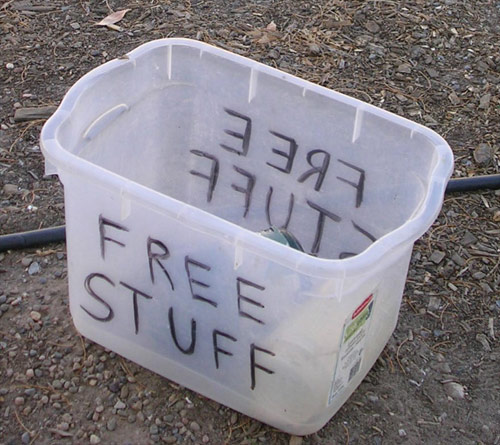
Now this is the part where people will find a way to deride what is A) An eco-friendly initiative and B) Free damn coffee because it's Starbucks. I can hear it now: "They just want to save money by not using paper cups. And besides, it's shameless pimping for their own tumblers".
Fine. Even if we grant that Starbucks, the big evil corporate monolith that it is, hasn't any moral fiber, it's still free coffee. Free. Coffee. The why of it needn't be benevolent. That, in this case, it is, only serves to make an already sweet deal even tastier.
April 14, 2010
Instant gratification

My generation is famous for it. If the yuppies of the eighties needed cocaine to fuel their buzz, we're too busy to stop and snort it. Maybe if there were some easier, more convenient way to get our fix... maybe if coffee only took a couple minutes to prepare...
Enter VIA, Starbucks' foray in to the instant coffee market. Ahem. Check that. According to Starbucks, VIA is not instant coffee, but rather "microground". The idea is that 100% arabica coffee is ground so infinitesimally small that it can be dissolved in water straight away. I don't pretend to grasp the science, nor do I care to. My only concern is whether VIA holds up under taste scrutiny.
I was inspired to try this by a comment on my previous post, which mentioned Folgers' coffee/tea bag pouch things. I picked up a box of Kroger brand bags and a three pack of Starbucks Columbia VIA.
Both were served using 8 oz of near boiling water, as per the directions.
The comparison:
Price: Kroger - About $3.50 for 19 bags. Starbucks - $3 for three packs.
Method: Kroger - The bag is steeped for just over one minute, a la tea. Starbucks - The contents of one pack is stirred in to near boiling water.
Aroma: Kroger - Slightly pungent and syrupy. Starbucks - Rich and full, eerily similar to Starbucks regular Columbia roast.
Taste: Kroger - While the smell is a bit too strong, if not overly pleasant, the taste is weak. The coffee tastes thin and whispy, and lacks any body or strong flavor. Starbucks - The taste picks up where the smell left off. The coffee is hearty, dense and smooth. While there isn't anything interesting going on in the flavor department, the result is still satisfying.
Verdict: Kroger - Cheap as can be, but still not quite worth the investment. The quality of the product just isn't there. Which shouldn't be surprising, given that it includes "coffee oils" as an ingredient. Starbucks - At about one dollar a cup, VIA is hardly the sort of thing you want to start every morning with. It also lacks the nuance of properly brewed coffee. Even still, in a pinch, VIA offers salvation for those who need real coffee flavor, but don't have access to real brewing methods.
April 13, 2010
The green apron wearing elephant in the room

This also gives me a platform to announce Starbucks initiatives, which may otherwise be missed -- although that isn't terribly likely.
For example, on April 15, Starbucks will give you a free cup of brewed coffee, provided you bring your own tumbler. Call it an early Earth Day celebration, or whatever you like. I'll simply call it free coffee. Or, in other words, a miracle.
Subscribe to:
Posts (Atom)