The vast majority of my writing here is not planned in any real sense, but is instead an outpouring of spontaneous thought. Maybe this gives it a certain "urgent" quality; maybe it just seems hurried; maybe it's just awful. But there are certain ideas that have bounced around my head for some time, sitting there, collecting dust, doing nothing in particular.
One of these ideas is to say something about my milkman.
I would like to say that he is nice, that he is good at his job, and that we should remember to thank people like him. There are a lot of parts and pieces that have to come together to make a coffee bar work well; us barista folks are really the last link on that chain. And though it's tempting to think that we're the talented craftsmen the people are clamoring for, the truth is a little more humbling - but no less true.
So, the milkman. I'm not going to say his name, or give any real details about him, because I don't know that that would be appropriate. I've made the decision to exist as myself on the internet; he has not. And I won't simply tell you that he is nice, or that he is good at his job - although both of those things are true.
He's nice, in the folksy and chatty way you expect the classic, black and white TV milk man to be. He also made our staff cinnamon rolls (he sells these at the local farmer's market, and they are not from a cannister) today, which is a small gesture that managed to make several people very obviously happy.
So, there's that.
Also, on the instance that I forgot to order any milk at all, he filed and delivered an order for me, averaging together what I had ordered the last several weeks to form a reasonably accurate guess of what I'd need. I'd have been fucked without that.
And I'm looking at this now, remembering why I never seem to publish this. I want to tell you that he's nice and that he's good at his job - and I've done so. But it's hard not to look at the words on the screen in front of me and know that I've failed somewhat, that I've fallen horribly short in depicting what a genuinely good guy he is, and has proven to be over the nearly 4 years he's delivered dairy for me.
Very soon, however, I will click "Publish". If you're reading this, I've already done so, of course. (Isn't this whole present tense writing thing awkward?) I'm not doing this because I think I've given the man a fair account, a glamorous profile, or even written a decent post. I'm doing this because there are people who make your job both possible and more enjoyable, people like my milk guy, and we really can't thank them enough.

Showing posts with label milk. Show all posts
Showing posts with label milk. Show all posts
December 11, 2012


October 19, 2012
Consider the Cow
I've lived in Kansas my entire life, more or less, which means a lot of things, but I'm going to take this somewhere you're not expecting. This is not about The Wizard of Oz (please), hills (we have them), or general ass-backwards education policy (no arguing that, sadly).
No, this is about cows. Stay with me.
Living in Kansas, cows have been somewhat omnipresent in my life. If you drive anywhere outside of any town, you see them. You may in fact smell them from further away, particularly if you venture near some of the less "free range" operations. This state's history, even, is largely defined and created by the cattle trade, the iconic longhorns being driven up from Texas, through the towns of the wild west.
Despite this closeness - or perhaps because of it - I've never really thought a great deal about cows. They seem, after a while, like scenery. You see them, but they lack the graceful power and spectacular musculature of horses, the personality and cuddliness (a technical term) of dogs and cats, and so they're more or less dismissed.
This weekend, however, I thought about cows, when I was charged by one. Heartland - the race I was running - largely takes place on private pasture, and as such, cows sometimes mill about. But about 16 miles in to my race, one particular heifer had had enough milling, and felt the need to get some running in herself.
As I shuffled along, a heard a rustle, and then saw a great black mass hurtling towards me. I turned, and my headlamp illuminated (it was a night race) the silhouette of a large, black cow, a rippling mass careening right at me. "Oh fuck," I yelled, and darted off the side of the road, the absurdity of this whole thing not yet dawning on me. When it did, I laughed to myself, imagining DNF'ing a race due to injury sustained via cow trampling. This was not Pamplona, after all.
At work and decidedly not trampled the next day, I set about ordering milk, which we all know comes from cows, but I'm not so sure that we know it. That is, milk comes from a plastic jug, the grocery, and the milk guy who brings it there. It is a white foodish liquid that we use to make drinks, pour pretty designs, and generally center our barista lives around. It is a commodity and an artistic tool, but not something that actually comes from a living thing - which of course, it is.
Now, I don't do calls to action, or editorial pieces. My style - insofar as I have one - is to throw ideas out there in a somewhat coherent (hopefully) stream of consciousness. So I'm not going to tell you that cows are people too (there are better and more articulate sources for that already), or that you should think or feel a certain way about them.
What I am suggesting is this: In an age where we're justifiably concerned about farm-to-cup coffee sourcing, and everything that goes along with that, perhaps we could spare a moment's thought for those other farms, and those other producers, without which we wouldn't be able to do our jobs. So while I'm not trying to tell you what to think of cows, I would like to say that maybe you try thinking about them at all.
No, this is about cows. Stay with me.
Living in Kansas, cows have been somewhat omnipresent in my life. If you drive anywhere outside of any town, you see them. You may in fact smell them from further away, particularly if you venture near some of the less "free range" operations. This state's history, even, is largely defined and created by the cattle trade, the iconic longhorns being driven up from Texas, through the towns of the wild west.
Despite this closeness - or perhaps because of it - I've never really thought a great deal about cows. They seem, after a while, like scenery. You see them, but they lack the graceful power and spectacular musculature of horses, the personality and cuddliness (a technical term) of dogs and cats, and so they're more or less dismissed.
This weekend, however, I thought about cows, when I was charged by one. Heartland - the race I was running - largely takes place on private pasture, and as such, cows sometimes mill about. But about 16 miles in to my race, one particular heifer had had enough milling, and felt the need to get some running in herself.
As I shuffled along, a heard a rustle, and then saw a great black mass hurtling towards me. I turned, and my headlamp illuminated (it was a night race) the silhouette of a large, black cow, a rippling mass careening right at me. "Oh fuck," I yelled, and darted off the side of the road, the absurdity of this whole thing not yet dawning on me. When it did, I laughed to myself, imagining DNF'ing a race due to injury sustained via cow trampling. This was not Pamplona, after all.
At work and decidedly not trampled the next day, I set about ordering milk, which we all know comes from cows, but I'm not so sure that we know it. That is, milk comes from a plastic jug, the grocery, and the milk guy who brings it there. It is a white foodish liquid that we use to make drinks, pour pretty designs, and generally center our barista lives around. It is a commodity and an artistic tool, but not something that actually comes from a living thing - which of course, it is.
Now, I don't do calls to action, or editorial pieces. My style - insofar as I have one - is to throw ideas out there in a somewhat coherent (hopefully) stream of consciousness. So I'm not going to tell you that cows are people too (there are better and more articulate sources for that already), or that you should think or feel a certain way about them.
What I am suggesting is this: In an age where we're justifiably concerned about farm-to-cup coffee sourcing, and everything that goes along with that, perhaps we could spare a moment's thought for those other farms, and those other producers, without which we wouldn't be able to do our jobs. So while I'm not trying to tell you what to think of cows, I would like to say that maybe you try thinking about them at all.
August 2, 2011
Milk Curls

(Note: Biceps written about below may be somewhat smaller than those picture above)
People will tell you that curls provide no benefit when it comes to functional strength. And they will tell you, furthermore, that functional strength should be your goal, if you spend any time at all pursuing fitness. They might say something caked in physiological terminology, or they might appeal to some romantic notion of an imagined past.
These people are wrong. They are wrong that the only viable reason to work out is to develop one's ability to chase down an antelope on the Paleolithic savanna, and then carry the carcass home. And they are wrong, specifically, that the biceps aren't important enough to merit targeting.
How do I know this? I'm not a strength coach, or an athlete of any merit. And I'm not even jacked. But I did carry three gallons of milk in each hand today, up two flights of stairs, then a couple hundred yards outside.
The Crossfit brigade can keep their kipping pullups.
May 14, 2011
Soy Bomb
I was reading this the other day, and was surprised, since I had never really entertained the idea that a coffee bar might not offer soy. It's become so ubiquitous, not just in cafes, but American culture in general, that the omission of soy seems very much a noteworthy thing. And yet it's not presented as that, in this case. Rather, it's simply a matter of taste. Soy doesn't work well with coffee, so it will not be offered.
Naturally, some people were offended by that notion. And I can't imagine such a move playing well in any cafe I've ever worked.
There are those who prefer the taste, and on that subject, I can hardly say they're incorrect. There is a certain subjectivity to that sensory experience that can't be denied. And yet, even trying to be objective, I feel that there is the matter of quality, that actual milk might be tangibly superior to soy. Certainly, it's more traditional; but that alone isn't sufficient justification. So no, as much as I might like to, I don't think I can say that actual dairy tastes better than soy, with or without coffee. There just isn't a way to measure it.
That brings me to the health argument. You'll not find a more controversial food than milk -- except, perhaps, soy. Both are held up as near panaceas, perfect proteins that build muscle, burn fat, cure cancer, etc. But both are also hormone destroying killers as well, depending on who you listen to. So who's right. Well, I am. Or more accurately, the research is. Despite what the vegan armada would have you believe, lactose tolerant persons have no reason to avoid dairy. In fact, people probably should consume more of it. The protein in milk is isolated and sold as supplements, as is conjugated linoleic acid, a fatty acid found in milk. Dairy is also high in stearic acid, a saturated fat has numerous document health benefits. This is not to say that soy is nutritionally void, just that it's not the powerhouse that dairy is.
Some drink soy for reasons other than preference, however. They might be lactose intolerant, or allergic to casein or whey. In any case, they have no choice but to avoid dairy. For them, soy can be useful, insofar as it allows a passable latte experience. Of course, some would argue that said latte is not passable, and that the customers would be better off drinking black coffee. I agree with that, for myself. But again, there's no accounting for individual taste, which varies infinitely.
All of this presumes that soy's quality matters, to an extent. Perhaps it's irrelevant that soy may or may not ruin coffee, or that it may or may not spike estrogen levels (it doesn't). Maybe all that matters is that some customers are going to want it, therefore coffee bars ought to have it. Nice as that sounds, it doesn't logically follow. A customer might well like a great many things, all of which no coffee bar can accommodate. They might want a pancake flavored syrup, and we may not have that. True, if the shop down the road does, we may lose that customer. But that's the vote of the market -- the only vote that really counts in business.
September 7, 2010
Speculation on dairy
Usually, when I pose something of a question, or a problem, I do so with the ultimate aim that I reveal the answer. The purpose of a blog is nothing if not to make its writer look smart. And so I do try to have all the answers -- even the wrong ones.
But not today. Today, I wonder about goat's milk.
I'd just like to pause for a moment here, and let that last sentence sink in. *exhale* OK.
In all seriousness, goat's milk is the most consumed form of dairy in the world, favored just about everywhere but the United States. I could go on about its fatty acid profile, its high levels of calcium, or its unhomogenized fat globules -- but I won't.
Instead, I will speculate idly on how goat's milk would steam, and otherwise perform, when used with coffee. In the realm of taste, goat's milk skews a bit towards UHT treated cow's milk, in so far as it tastes rather overtly sweet. Even in its fattier incarnations, goat's milk just doesn't have the same inky thickness that whole cow's milk does.
Thus one can reasonably assume that goat's milk would taste even sweeter when steamed, as some of the sugars would caramelize. How unhomogenized milk would stretch, however, is something of a mystery to me. The fat globules are small enough (the reason why it isn't homogenized in the first place) that I don't think you'd end up with a lumpy latte. Either shake the container first, as you would with any non-dairy milks, or count on the swirling action during steaming to do the work. I imagine it probably would.
Of course, I don't actually have experience with a goat's milk/espresso combination. Nor do I have the slightest clue where one might go about finding a place to accomplish as much. But an interesting item to ponder, none the less.
But not today. Today, I wonder about goat's milk.
I'd just like to pause for a moment here, and let that last sentence sink in. *exhale* OK.
In all seriousness, goat's milk is the most consumed form of dairy in the world, favored just about everywhere but the United States. I could go on about its fatty acid profile, its high levels of calcium, or its unhomogenized fat globules -- but I won't.
Instead, I will speculate idly on how goat's milk would steam, and otherwise perform, when used with coffee. In the realm of taste, goat's milk skews a bit towards UHT treated cow's milk, in so far as it tastes rather overtly sweet. Even in its fattier incarnations, goat's milk just doesn't have the same inky thickness that whole cow's milk does.
Thus one can reasonably assume that goat's milk would taste even sweeter when steamed, as some of the sugars would caramelize. How unhomogenized milk would stretch, however, is something of a mystery to me. The fat globules are small enough (the reason why it isn't homogenized in the first place) that I don't think you'd end up with a lumpy latte. Either shake the container first, as you would with any non-dairy milks, or count on the swirling action during steaming to do the work. I imagine it probably would.
Of course, I don't actually have experience with a goat's milk/espresso combination. Nor do I have the slightest clue where one might go about finding a place to accomplish as much. But an interesting item to ponder, none the less.
June 23, 2010
Milk: It does espresso good

Thus, a brief update. My pancreas is fine. Because of my increased ability to digest things properly, milk no longer seems to be a bother. This is better news than I can put in to words. Because, once again, I can enjoy the velvety perfection that is embodied in milk foam. Perfection, that is, so long is it's topping a cappuccino.
I've talked about steaming milk before. And I'm sure that I'll talk about it again, as it's that important. But, just for a moment, let me discuss the types of milk available for your espresso beverages, and which are best.
There is, of course, skim, which some might argue is not really milk at all, but rather a watery emulsion of lactose, whey and casein. Some people might say that, but I would not. Skim milk is still milk, in the same way that a steak with the fat trimmed off is still a steak. Unfortunatley, that's about all the nice things I have to say about skim milk. Its lack of fat means two things: First, that even when steamed, it lacks the body of fattier dairy; And second, that it lacks the flavor.
The next step up on the fat-o-meter is 2%, which many coffee bars don't offer. The theory, I suppose, is that skim is for the calorie watchers, whole is for everyone else. Half & half, then, is for the militant. Despite that fact, king of coffee, Starbucks, uses 2% as its standard for espresso beverages. As you would expect, 2% offers more flavor and texture than skim, but less than whole. The question, then, is how much difference is there?
Not an insignificant amount. A simple slurp and swirl is enough for the moderately learned palate to differentiate between the three options.
Whole, predictably enough, tends to be the agreed upon best choice in the industry. The old culinary truism that fat equals flavor holds true in this regard. The fat really does enhance the espresso, as well as provide a delicious aroma. When you're drinking from a saucer or lidless cup (which is to be recommended) this fact is not to be underestimated. But it really is the texture that makes the biggest difference. Milk is steamed in order to stretch and aerate it, to create a pillowy mass of infinitesimal microfoam. Less fatty dairy simply does not have the structure to hold as luscious a structure as whole milk does.
But there is the matter of diminishing returns. While fat does equal better flavor and texture, too much fat is still possible. I would argue that a breve beverage (made with half&half) doesn't quite cross that line, but it certainly does toe it. The body is heavy and rich, almost approaching cheese territory. The lack of lactose also means, not surprisingly, that the beverage is less sweet. Thus, for a breve beverage to be best, it requires a stronger (or simply more) espresso to cut through the fat and add a touch of sweet.
And heavy cream? I don't know, and I don't want to.
May 6, 2010
Meet carrageenan
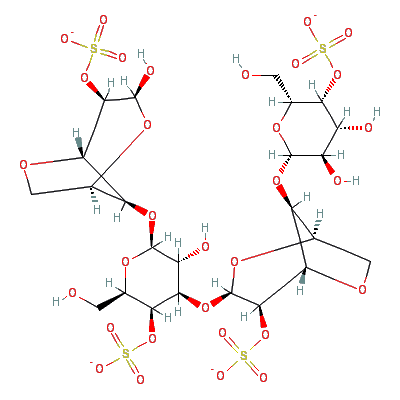
That's because carrageenan is one of the many mystery ingredients you see (or choose not to see, in some cases) on ingredient lists everywhere. It's a polysaccharide (complex sugar) which is used as a commercial thickener, extracted from red seaweed.
Although you'll find it in just about everything, carrageenan is frequently used in beverages to mimic a creamy texture where one does not actually exist.
Like, I don't know, non-dairy milks and low-fat milks? As it turns out, yes.
Silk, the big brand name in soy milk, uses the thickener in their products. So too does Starbucks use it in their Silk knock-off.
Now you might think milk is creamy and thick enough. Apparently, you would be wrong. Skim milk frequently uses carrageenan. Which one might expect, given that skim milk has the texture of chalkly water otherwise. But even some brands of half & half and heavy cream (seriously) aren't thick enough in their natural state, apparently.
Carrageenan's ubiquity wouldn't be worth writing about, if not for two things: First, many people (myself included) prefer their foods to be simply what they are. Second, a rat study suggests that carreegeenan may cause cancer.
Wait, hold the phones. Cancer? Seriously? What doesn't cause that now days?
This might be cause for concern. Might be, because humans are not rats, the amount of carrageenan which was shown to be potentially dangerous was way more than one could reasonably ingest, and the product was degraded. This strikes me as similar to studies which show that OXIDIZED cholesterol (not the kind you eat) caused heart disease in rabbits (not capable carnivores like humans).
In this case, vague correlation does not imply, much less guarantee, causation.
Which means, at the end of the day, don't worry about it. Do I prefer my soy milk (Westsoy) to be only soybeans and water? Sure. But I don't think that a few glasses of Silk will give me cancer, either. Nor should you fret over whether your milk is just milk, or contains other stuff.
Subscribe to:
Posts (Atom)